Openness in Multiagent Systems: Lessons from Modeling with Graph Neural Networks
Dec 06, 2025
Reflections on simulating open environments and using GNNs to model dynamic, unpredictable multiagent systems.
- multiagent systems
- GNN
- openness
- research
- simulation
Introduction
This blog post is a reflection on my ongoing research into multiagent systems-computer simulations where agents interact in unpredictable environments—and how I’m using graph neural networks (GNNs) to model them. Here, I share what “openness” means, the challenges I’ve faced, surprises along the way, and how this experience is shaping my perspective and future goals.
My aim is not only to sum up what I’ve learned so far technically, but also to share personal growth and insights from the process. I hope this reflection is useful to anyone interested in multiagent systems, GNNs, or the messy reality of modeling open environments.
What is “Openness” in Multiagent Systems?
Openness is all about change and unpredictability. In an open system, things don’t stay the same for long. Here are a few ways that can happen:
- Agent Openness: The “agents” in the system-like people, robots, or cars-can show up or leave whenever they want. Imagine a ride-sharing app: drivers and riders come and go all the time. Or think about a team of firefighters-sometimes new people join the team, and sometimes someone has to leave early.
- Task Openness: The jobs that need doing can appear or disappear, sometimes randomly or because of something happening in the world. For example, after a football game ends, suddenly a bunch of people need rides home. Or in a wildfire, new fires can start unexpectedly, creating new tasks for the team.
- Frame Openness: What an agent can do might change. Maybe a firefighter’s equipment breaks, so they can’t help as much, or they get new gear and become more effective. In other words, the abilities and resources of each agent aren’t fixed—they can change over time.
All this makes it much harder to predict what will happen next, or to design systems that can handle whatever comes their way. In closed systems, you know exactly who’s involved and what needs to be done. In open systems, you have to be ready for surprises.
Why Does Openness Matter?
Openness isn’t just a computer science problem—it’s everywhere in real life. Think about:
- Public transportation: Buses and trains have to deal with passengers coming and going, traffic jams, and sudden changes in demand.
- Disaster response: Teams must adapt to new emergencies, changing team members, and unpredictable conditions.
- Online platforms: Social networks, games, and apps constantly see new users join, old users leave, and new features or problems pop up.
If we want to build systems that work well in the real world, we need to understand and model openness.
Modeling Openness with Graph Neural Networks
To try to make sense of these open systems, I used something called a graph neural network (GNN). You can think of a GNN as a way for a computer to look at a big web of connections—who’s connected to what, who’s working on which task, and so on—and learn patterns from it.
Imagine a map with dots for each agent and lines showing how they’re connected or what tasks they’re working on. The GNN helps the computer “see” this map and figure out how everyone should act, even as the map changes.
But modeling openness with GNNs wasn’t easy! Here’s why:
- The web keeps changing: Since agents and tasks can come and go, the graph of interactions between entities in the environment is always shifting. The model has to keep up with modeling all of these interactions.
- Surprises happen: Sometimes, a bunch of new tasks show up at once, or an agent suddenly leaves. The model needs to be flexible.
- Abilities change: If an agent gets stronger or weaker, the model has to notice and adapt.
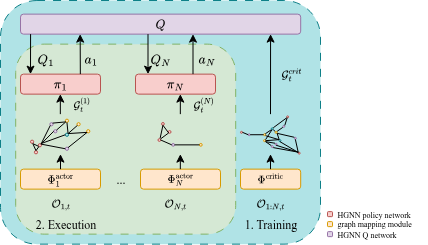 Figure: The architecture I used for my research. It helps the system keep
track of all the changing connections between agents and tasks.
Figure: The architecture I used for my research. It helps the system keep
track of all the changing connections between agents and tasks.
A Real-World Example: Fighting Wildfires
To test my ideas, I used a simulation inspired by wildfire response. Imagine a team of firefighters working together to put out fires. Here’s how openness shows up:
- Agents: Firefighters might run out of suppressant and have to leave, or new firefighters might arrive from refilling their suppressants.
- Tasks: New fires can start at any time, and old ones can be put out or burn out.
- Frames: A firefighter’s equipment might break or degrade, or they might get new tools. This can make them less effective in their work and decrease their capabilities.
The system has to be able to globally coordinate in order to put out as many fires as possible according to a pre-determined priority function, while at the same time not having any one agent have to think about the complexity of the entire system. This means that each agent has to decide which teammates are relevant to the tasks that they can see and want to work on, and adapt as their collaborators enter and leave the environment and capabilities change. It’s a lot like real life-plans change, people come and go, and new problems pop up.
What Was Hard, What Surprised Me, and What I Learned
What Was Hard
- Building a flexible model: I had to design a system that could handle all the changes without starting over every time. It’s like trying to organize a team when you don’t know who will show up or what jobs will need doing.
- Staying stable: When things changed suddenly—like a bunch of new fires starting—the system sometimes got confused or made bad decisions.
- Creating realistic tests: I wanted my simulations to feel like real life, with all its unpredictability. That meant thinking carefully about how agents and tasks could change.
What Surprised Me
- Simple rules sometimes win: In really unpredictable situations, sometimes basic strategies (like “help the closest fire”) worked better than complicated ones.
- Details matter: The way I set up the “openness” in my tests made a huge difference in how well the model worked. Small changes could have big effects.
- Good data is crucial: Knowing exactly when agents and tasks appear or disappear helped the model make better decisions.
What I Learned
- Flexibility is key: Models (and people!) need to be ready for change. The best systems aren’t rigid—they adapt.
- Embrace the mess: Real-world systems are rarely neat and predictable. Accepting the messiness leads to better solutions.
- Teamwork matters: Whether you’re an agent in a simulation or a researcher in a lab, working together and sharing ideas makes a big difference.
How This Project Changed My Perspective
Before this project, I thought most computer models worked best when everything was predictable. Now, I see that the real world is full of surprises, and the best models are the ones that can handle change. I’m more comfortable now working with things that don’t always go as planned, and I see the value in building systems that can adapt on the fly.
I also learned how important it is to explain these ideas in simple terms. If we want our work to help others—whether in research, industry, or everyday life—we need to make it understandable.
Looking Ahead
The skills and insights I gained from this project will help me in future classes, research, and even jobs. I know how to:
- Work with dynamic, unpredictable systems.
- Build models that can adapt and learn as things change.
- Communicate complex ideas in a way that makes sense to everyone.
I’m excited to keep exploring these ideas and see how they can be used in other fields-like transportation, healthcare, or even social networks. Modeling open environments is challenging, but it’s also exciting and full of surprises. If you have questions or want to chat more about this kind of research, feel free to reach out!